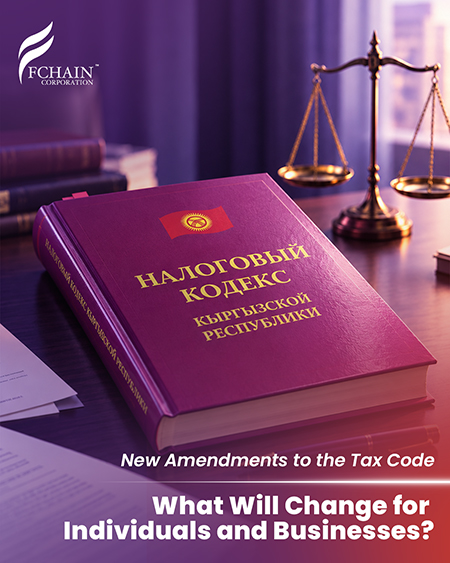

A total of 113 amendments are being introduced to the Tax Code of Kyrgyzstan. This was announced by Member of Parliament Dastan Bekeshev on his WhatsApp channel.
According to Bekeshev, the government aims to strengthen tax administration, digitize more procedures, close certain tax evasion schemes, and clarify specific tax regimes.
Bekeshev highlighted the key changes that may affect individuals and businesses.
Electronic tax reporting
If tax returns are submitted digitally, more documents will be allowed to be sent through electronic systems, reducing the need for paper documents.
Termination of tax obligations upon death
If an individual dies, their tax obligations and tax debts will be terminated as of the date of death. The tax authorities will receive information about deaths through integration with the state population register.
Access to fiscal software data
If a business uses fiscal software, the tax authorities will be able to access the system’s data during tax inspections. This measure is intended to prevent data manipulation and the concealment of revenue.
New concepts for tracking the origin of goods
The amendments introduce the concepts of “non-existent goods supply” and “source of origin of goods.”
“In simple terms, the tax authorities want to see not only the documents but also the actual origin of goods: where they were purchased, produced, or obtained. If goods exist only on paper and no actual delivery takes place, such transactions may be classified as non-existent supplies. Something similar occurred during the introduction of electronic consignment notes (ETTN), when the government sought to track the movement of goods from suppliers to buyers,” the MP explained.
Access to banking and electronic payment information
Banks, electronic money operators, and payment systems will be required to provide the tax authorities with information on account and electronic wallet balances and transactions when a tax payment demand has been issued.
Bekeshev believes that access to such information should be limited to what is necessary to enforce the specific tax demand.
Introduction of a tax services operator
The amendments also propose introducing a tax services operator.
“This could be a legal entity providing taxpayers with electronic services and other services to help them fulfil their tax obligations and access tax-related services. Such services may be convenient, but their use should be voluntary,” the MP said. “Individuals and businesses must retain the option to contact the tax authorities directly without being required to use an intermediary.”
Reporting requirements for non-residential properties
The amendments also seek to clarify reporting requirements for non-residential properties. For example, if a non-residential structure is not registered in the Cadastre, its owner may be required to submit an informational tax calculation to ensure that the property is not excluded from taxation.
Electric vehicle charging
The proposed changes would establish a clearer distinction between household electricity consumption and commercial electric vehicle charging.
This means that tax benefits applicable to household electricity consumption should not automatically extend to charging stations.
Changes to the single tax regime
The amendments propose simplifying the wording regarding payment deadlines under the single tax regime.
“However, there is a risk of confusion: one article removes the explicit distinction between small, medium-sized, and large businesses, while another retains it,” Bekeshev noted. “I propose keeping the clearer wording so that taxpayers can understand the payment deadlines precisely.”
He added that while some of the amendments are technical, others directly affect businesses, individuals, tax confidentiality, banking information, goods accounting, and tax benefits.
Registration of Foreigners and Stateless Persons in Kyrgyzstan