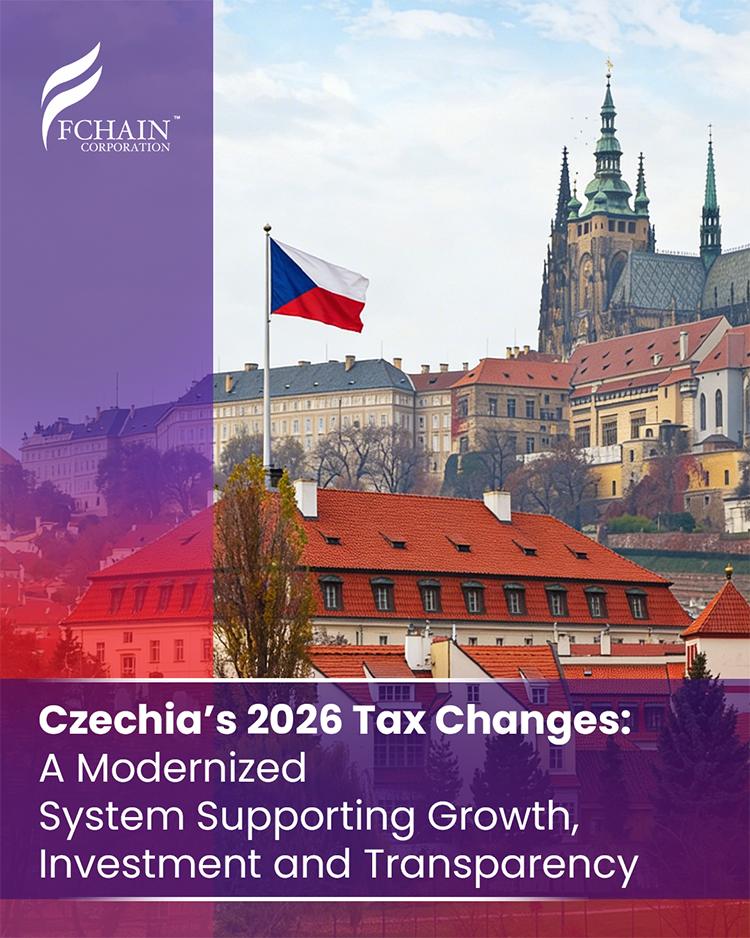
Czechia’s 2026 Tax Changes: A Modernized System Supporting Growth, Investment and Transparency
Czechia’s 2026 tax reforms are now officially underway, bringing updates to income thresholds, social contributions, reporting systems, and investment rules. While any tax change requires adjustment, this year’s reforms largely reflect rising wages, economic growth, and the government’s push toward modernization and digital efficiency. For employees, entrepreneurs, investors, and international professionals, the key message is preparation and opportunity.
Higher Income Tax Threshold Reflects Wage Growth
In 2026, the threshold for the 23 percent personal income tax rate has increased to approximately CZK 1.76 million annually (around CZK 146,000 per month).
Individuals earning below this level continue to pay the standard 15 percent rate.
The adjustment mirrors rising average wages in Czechia and ensures that more middle-income earners remain within the lower tax bracket. For skilled professionals and expats, this is a sign of a strengthening labor market and a tax system adapting to economic realities.
For employees on short-term contracts (DPP agreements), the threshold for mandatory social and health insurance contributions has increased to CZK 12,000 per month. Registration of DPP agreements is now required, improving transparency while keeping pace with wage growth.
A Major Step Toward Digital Simplification
One of the most business-friendly developments is the introduction of the Unified Monthly Employer Report (JMHZ). This reform replaces approximately 25 separate filings with a single digital submission to the Social Security Administration.
The result:
- Reduced administrative complexity
- More efficient payroll reporting
- Greater clarity in employer-state communication
Companies have until April 2026 to complete the transition, allowing sufficient time to update payroll and HR systems.
Stronger Investment Climate
A particularly positive development for investors is the repeal of the CZK 40 million exemption cap for traditional securities. Under qualifying conditions, capital gains can now be tax-free without an upper limit.
This move strengthens Czechia’s appeal as an investment-friendly environment and signals confidence in the country’s financial markets.
The exemption cap remains in place for crypto assets, meaning gains above CZK 40 million from cryptocurrency are still subject to standard income tax rates. This balanced approach combines investor support with prudent regulation.
Improved Tax Treatment for Employee Stock Options
From January 2026, the Income Tax Act introduces a new category of employee stock option plans with more favorable tax treatment, provided certain legal conditions are met.
Income from qualifying stock options will no longer be treated as employment income but as “other income.” As a result, it will not be subject to social security or health insurance contributions.
For startups, technology firms, and multinational companies operating in Czechia, this change enhances competitiveness in attracting and retaining talent.
Clearer Rules for Foreign Statutory Representatives
The previous 15 percent final withholding tax for statutory representatives who are Czech tax non-residents has been abolished.
Their income will now be taxed under the standard payroll system and progressive income tax rates of 15 percent or 23 percent, depending on total annual earnings.
While this introduces standard filing obligations for higher earners, it also aligns taxation with general rules and increases consistency within the system.
Updated Contributions for the Self-Employed
Minimum monthly contributions for self-employed individuals have increased in 2026:
- Health insurance: CZK 3,306
- Social insurance: originally set to rise to CZK 5,720
- Flat-rate tax (Band 1): CZK 9,984
- Bands 2 and 3 remain CZK 16,745 and CZK 27,139
Importantly, those who began their self-employment activity in 2024 or later benefit from reduced social insurance deposits of CZK 3,575 this year.
Although contributions are rising in line with income growth, the system continues to offer structured, predictable options for entrepreneurs — particularly through the flat-tax regime.
Employee Benefits: Transparency and Defined Limits
Changes to employee benefit taxation bring clearer guidelines. Only benefits not directly linked to wages or work performance remain fully tax-exempt.
For 2026, annual exemption limits are:
- CZK 48,967 for health-related benefits
- CZK 24,483.50 for leisure benefits
When provided in addition to salary — not as a replacement — these benefits remain tax-efficient tools for employers to enhance compensation packages.
Gradual Increases in Excise Duties
Excise duties will rise modestly in several categories:
- Spirits: +5 percent
- Cigarettes and tobacco products: +5 percent
- Heated tobacco products: +15 percent
These increases are part of the broader fiscal consolidation package introduced in 2023 and reflect the government’s long-term public health and revenue strategy.
Preparation and Planning Are Key
Czechia’s 2026 tax reforms touch multiple areas — income taxation, investment, payroll reporting, social contributions, and employee benefits. While adjustments are required, the broader direction is clear: modernization, digitalization, and alignment with a growing economy.
For companies and individuals alike, early review of payroll systems, investment structures, and compensation models will ensure smooth compliance — and may even uncover new opportunities within the updated framework.
In a growing economy, tax reform is not just about obligations — it is also about building a more transparent and competitive environment for the future.