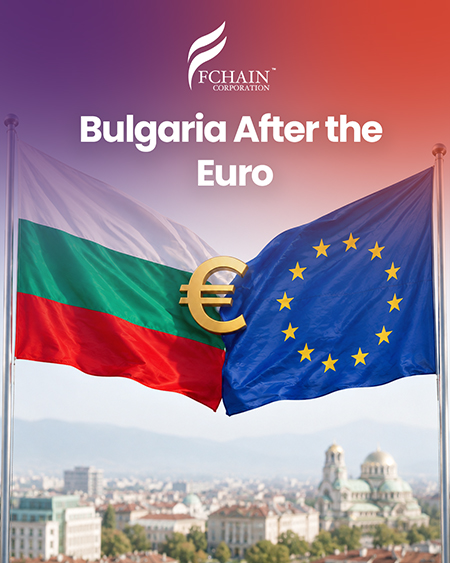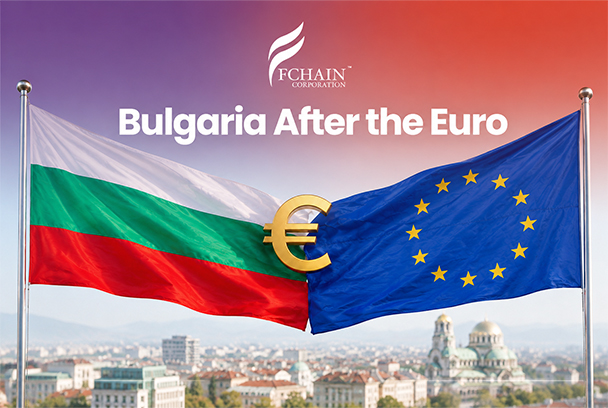
Since 1 January 2026, Bulgaria has been part of the euro area, becoming its 21st member. Several months after the transition, attention is shifting from the technical currency changeover to a more relevant question for international companies: What has actually changed for doing business in Bulgaria?
The adoption of the euro did not fundamentally change Bulgaria’s economic model, but it removed one of the remaining barriers between the country and its largest European business partners.
Simpler business across the euro area
Bulgaria adopted the Euro at the fixed conversion rate of EUR 1 = BGN 1.95583, maintaining the long-standing relationship between the two currencies.
For companies, operating directly in Euro brings practical advantages. Currency conversion between BGN and EUR is no longer required, exchange-rate exposure against the Euro has disappeared, and cross-border payments and invoicing have become more straightforward.
Accounting and financial administration have also changed. Tax declarations, VAT reporting, customs values and statistical reporting are now handled directly in Euro.
For international groups with Bulgarian operations, this can simplify budgeting, financial consolidation, payroll planning and comparisons between Bulgaria and other European markets.
Bulgaria’s business proposition after the Euro
Euro adoption also changes how Bulgaria can be viewed as an investment destination.
The country now combines EU membership, Schengen participation and euro-area membership, while maintaining a 10% corporate income tax and 10% personal income tax.
For companies evaluating Bulgaria for establishing an entity, building a local team or expanding existing operations, the removal of currency risk makes the country’s cost structure easier to evaluate against other Euro-area markets.
Euro adoption also provides Bulgaria with deeper integration into the European financial system. The Bulgarian National Bank now participates fully in the Eurosystem, while businesses operate directly within the monetary framework of the European Central Bank.
The longer-term effects on financing, investment and business confidence will become clearer over time, but the structural change is already significant.
How FCHAIN Bulgaria can help
For international companies, entering a new market involves more than choosing the right location. Local employment, payroll, accounting, tax and regulatory requirements remain important parts of establishing and managing operations in Bulgaria.
FCHAIN Bulgaria supports companies throughout this process through Employer of Record (EOR), payroll, HR, accounting, legal and company establishment services, helping international businesses manage their Bulgarian operations in line with local requirements.
Key Considerations for International Companies Entering Bulgaria