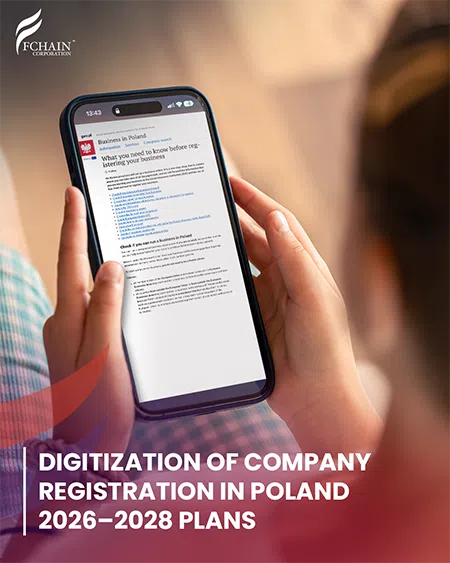

The Polish government is planning a series of reforms aimed at making the process of establishing a business simpler and more digital. According to a project announced by the Ministry of Development and Technology, these changes are scheduled to be implemented in phases between 2026 and 2028.
Key Features of the Plan
- Online Applications
Starting from November 1, 2026, all new business registration applications will be accepted exclusively in digital form. During this phase, physical documents and paper applications will be gradually phased out. - Digital Management
From 2028 onward, processes such as company suspension, continuation of operations, and closure will be fully digital, making administration more transparent and efficient. - “Single Digital Window” System
Under the new system, separate applications for the tax office, Central Statistical Office (GUS), and ZUS will no longer be required. A single application will suffice, with the system automatically synchronizing information and digitally processing millions of annual applications. - Integration with mObywatel App
Businesses will be able to register both via PC and mobile applications, making the process more accessible, especially for foreign and small-scale entrepreneurs. - Standard Contract Templates
For civil partnerships (spółka cywilna), standard contract templates will be provided, simplifying documentation and reducing administrative burden. - Important Notes
The information currently available does not constitute a legally binding law.
The project is still in the planning stage, meaning parliamentary discussion and approval have not yet been completed.
These changes will only take effect once the law is formally enacted, with the planned implementation phases set for 2026–2028.
In the near future, establishing a business in Poland is expected to become more digital, faster, and centralized. The currently announced plan aims to simplify the business environment, but its application will require formal legal approval. Entrepreneurs should monitor these developments and be prepared to comply with the new system once it becomes law.