• Home
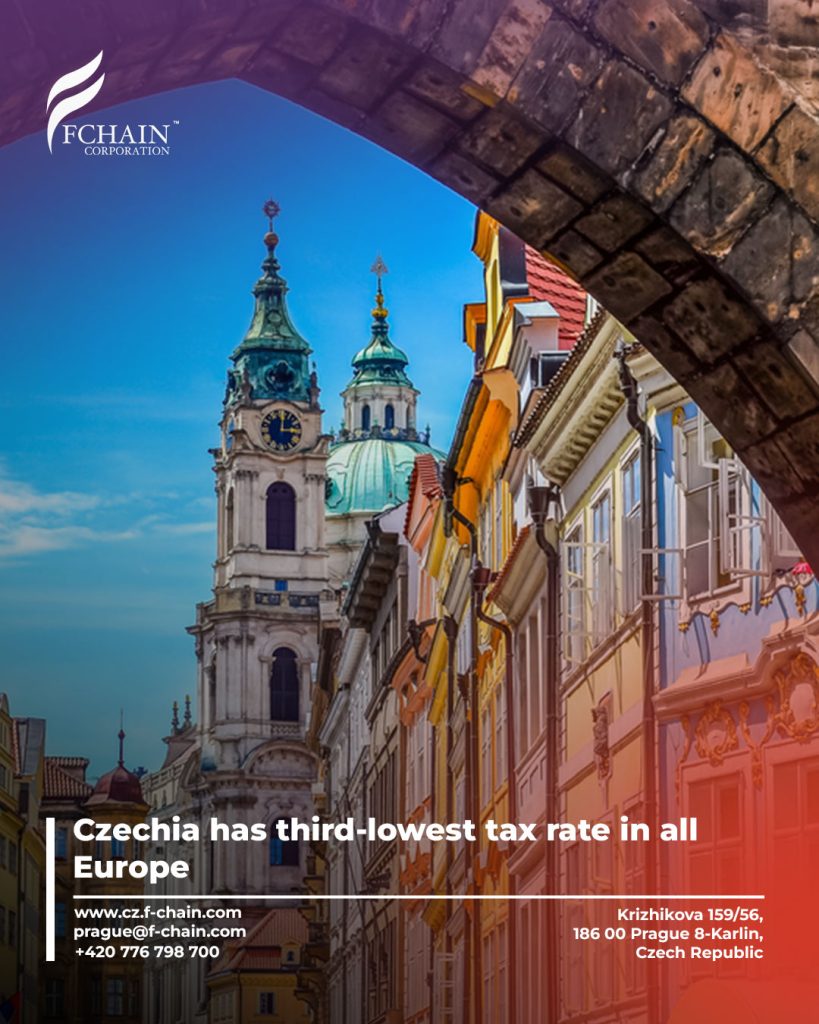
  • Czechia has third-lowest tax rate in all Europe

Czechia has third-lowest tax rate in all Europe

FCHAIN Czechia informs:

Despite a large 2023 austerity package that edged up taxes overall, Czechia’s relatively low personal-income and corporate tax rates remain attractive.

A new ranking based on the latest, official data from the World Bank has found that—out of all of Europe—Czechia has the third-lowest taxes overall for its residents.

Czech business-news site E15.cz summarized the different tax rates across various incomes. Czechia has different types of taxes, such as: personal, corporate, and real estate.

A low tax burden overall

“In a European comparison, the Czech Republic has maintained a low tax burden relative to GDP for a long time,” E15 writes. This reduces the burden on value-added tax (VAT) payers, which is mainly higher in Western countries. This is despite high state budget deficits in the last five years.

VAT itself is three-tiered in the Czech Republic: it comprises a basic rate of 21 percent, a reduced rate of 12 percent, and selected items have a zero rate.

Czechia’s major monetary policy overhaul of 2023, however, generally increased the tax burden for residents. For example, the VAT rate for beer jumped from 10 percent to 21 percent. Medicine, magazines, and newspapers also rose from 10 percent to 12 percent.

Europe’s lowest tax burdens

  • Switzerland
  • Germany
  • Czechia
  • Spain
  • Latvia
  • North Macedonia
  • Ukraine
  • Albania
  • Poland
  • Turkey

 Source: World Bank

A kind income tax

Czechia’s income tax rate is generally kind. The basic (lowest) rate is 15 percent, and if you earn four times the average wage across the course of a year (in 2025, this is about CZK 1.67 million in total), this rises to 23 percent. This also applied to self-employed workers.

The 23-percent figure is much lower compared to other EU countries. In sharp contrast, the highest statutory top personal income tax rate for Slovenia is 50 percent. This goes up to over 53 percent in Belgium and 55 percent in Austria.

Positively, all Czech tax residents are entitled to a basic personal tax relief of CZK 30,840 annually. This amount directly reduces the calculated tax, not the taxable income. ​

Real estate tax is harsher

In 2024, Czechia’s real estate tax rates rose by approximately 1.8 times compared to 2023 levels due to the country’s budget reform. For example, for an apartment or a family house, the rate increased from CZK 2 to CZK 3.5 per square meter.

Municipalities can now adjust property taxes using local coefficients ranging from 0.5 to 5.0, allowing for both increases and decreases in tax rates.

Corporate income tax

​As of 2025, the corporate income tax rate in Czechia is 21 percent, applicable to all companies regardless of their income level.

Certain large multinational enterprises with annual consolidated revenues exceeding EUR 750 million (CZK 18.7 billion) are subject to additional regulations under the EU’s global minimum tax directive.

Czechia’s 21-percent corporate tax rate is relatively high compared to other countries to the east of Europe: in Croatia it is 18 percent, in Romania 16 percent, and 10 percent in Bulgaria. However, Czechia’s corporate tax rate is lower than that of Spain (25 percent) and Italy (about 28 percent).

In sum

According to E15, Czechia’s tax burden relative to GDP is 15 percent, the third-lowest overall. “Small states, like Czechia, use favorable tax policies to attract foreign investors,” it notes.

Czechia’s (relatively) robust economy allows the government to maintain low tax rates. “The economy is strongly tied to industrial production, especially the automotive industry, mechanical engineering and electrical engineering,” the analysis finds.

Weaknesses include dependence on developments in Germany, relatively slow growth in labor productivity, and excessive regulations that can hinder business development.

  • Author: FChain Media

Public Relations Manager

24.04.2025
Back

Latest news

Georgia Raises Minimum Threshold for Foreign Currency Loans to GEL 1 Million
08.05.2026
Georgia Raises Minimum Threshold for Foreign Currency Loans to GEL 1 Million
In Georgia, individuals whose income is denominated in the national currency (GEL) will face tighter restrictions on borrowing in foreign currency. The decision was adopted by the Financial Stability Committee of the National Bank of Georgia. Currently, the minimum threshold for foreign currency lending to unhedged borrowers stands at GEL 750,000. However, starting July 1,
Read More
Nakhchivan Grand CEO Tour: Inside the “SİRAB” Production Plant
06.05.2026
Nakhchivan Grand CEO Tour: Inside the “SİRAB” Production Plant
Following the National Business Development Forum held in Nakhchivan, the participants visited the "SİRAB" plant—a leading manufacturing enterprise in the Nakhchivan Autonomous Republic—as part of the "Grand CEO Tour" project. Valid Huseynov, FChain Deputy General Director, reviewed the production capacities, advanced technologies, and quality control mechanisms on-site, observing the processes firsthand. During the meetings, fruitful
Read More
FChain Georgia Attends Information Sessions Organized by the International Organization for Migration
06.05.2026
FChain Georgia Attends Information Sessions Organized by the International Organization for Migration
FChain Georgia attended high-level information sessions organized by the International Organization for Migration (IOM) Georgia. FChain Georgia attended an informational meeting organized by the International Organization for Migration (IOM). The main topic of the session was the newly implemented regulations regarding the employment and self-employment of foreign nationals in Georgia. Approximately 130 representatives from various
Read More

Consultation

Contact us or find nearest office